Mastering Memory in C#: A Guide for Junior Engineers

A red and white floppy disk resting on a white surface, evoking classic computer memory storage.
Photo by Fredy Jacob on Unsplash
Mastering Memory in C#: A Guide for Junior Engineers
When you first pick up C#, it's tempting to file memory management under "things the runtime handles for me." And to be fair, the .NET garbage collector does handle an enormous amount of work on your behalf. But here's the thing: just because memory is managed doesn't mean it's free. The engineers who understand what's happening under the hood tend to write faster code, ship fewer mysterious bugs, and debug performance problems that leave others scratching their heads.
In this guide, we'll break down the two memory regions you'll meet most often — the stack and the heap — explain what lives where, and look at a few bad-vs-good patterns (with C# code you can read line by line) so you can start spotting wasteful code in your own projects.
1. The Stack
The stack is a small, fast, Last-In-First-Out region of memory. Think of it like a stack of plates: the last plate you put on is the first one you take off. C# uses it to store value types (like int, bool, and struct) along with method call data such as parameters and local variables.
The best part? You don't manage it. When a method finishes running, its slice of the stack is automatically cleaned up. The catch is that the stack is small, and you can run out of room.
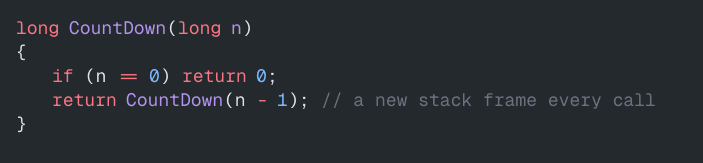
Bad pattern — deep recursion: Every call this method makes to itself adds another frame to the stack. Go deep enough and you'll hit the dreaded StackOverflowException, which crashes your program instantly and can't be caught.
Good pattern — iteration: The same logic rewritten as a loop reuses the same handful of variables instead of stacking up frames, so it runs comfortably no matter how large the input gets.
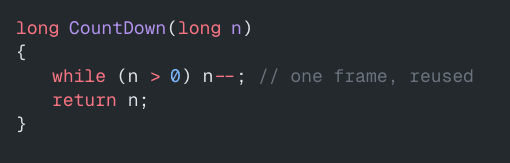
Rule of thumb: recursion reads nicely, but if the depth depends on user input or data size, reach for a loop instead.
2. The Heap
The heap is where reference types live — your class instances, objects, arrays, and strings. When you write new SomeClass(), that object is allocated on the heap, and your variable just holds a reference (a pointer) to it.
The heap is much larger and more flexible than the stack, but it comes with a cost: the garbage collector (GC) has to periodically pause your program, figure out which objects are no longer referenced, and reclaim them. The more garbage you create, the more often the GC has to work.
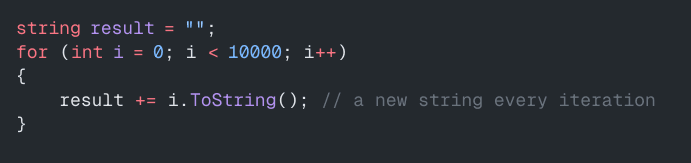
Bad pattern — allocating in a tight loop: Because strings are immutable in C#, every += creates a brand new string on the heap and throws the old one away. Ten thousand iterations means ten thousand short-lived objects for the GC to clean up.
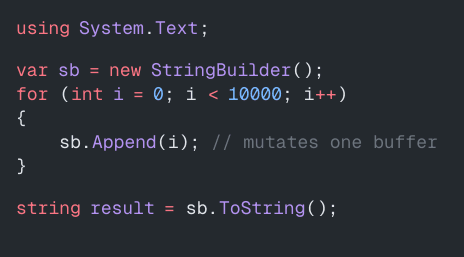
Good pattern — reuse and the right tool: A StringBuilder maintains a single internal buffer and appends to it, so you allocate once and grow as needed. Same result, a fraction of the garbage.
3. A Few Habits That Pay Off
You don't need to micro-optimize every line. But a handful of small habits keep your memory footprint healthy:
Prefer
structfor small, short-lived value-like data. Structs live on the stack and skip the GC entirely — but keep them small, because copying large structs around gets expensive. For example, a lightweightstruct Point { public int X; public int Y; }never touches the heap.Dispose of unmanaged resources. Things like file handles and database connections aren't cleaned up by the GC. Wrap them in a
usingstatement so they're released the moment you're done:

Don't hold references longer than you need. An object stays alive as long as something points to it. Static collections and event handlers are classic culprits for accidental memory leaks.
Measure before you optimize. Tools like the Visual Studio diagnostics window or
dotnet-countersshow you where allocations actually happen. Guessing is how you waste an afternoon optimizing code that was never the problem.
Wrapping Up
Memory in C# isn't something you fight against — it's something you cooperate with. The stack is fast and automatic but small, so avoid runaway recursion. The heap is roomy but watched over by the garbage collector, so avoid creating mountains of throwaway objects. Once these ideas click, you'll start reading code with a new kind of x-ray vision, spotting the wasteful patterns before they ever reach production.
You don't have to memorize all of this today. Just stay curious, write a little experiment when something surprises you, and let the understanding build over time. Your future self — and your application's performance — will thank you.
Until next time, Happy Computing!! RO out 🎤